Newsletter
Our Efforts
Our weekly newsletter: what we are doing to save the Mountain View, as it happens. The newest issue is first.
Get each issue by email.
Issue 1 · September 26, 2026
Mountain View Hotel nominated as one of America's most endangered places
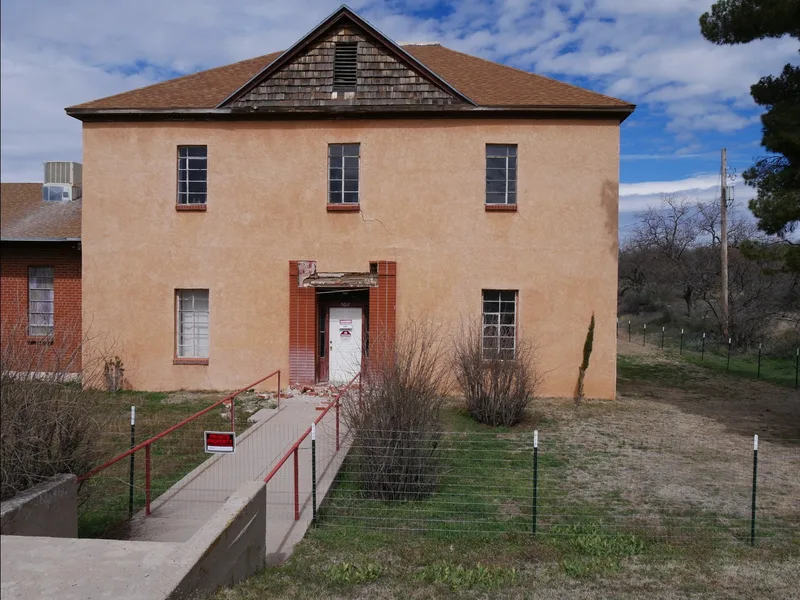
On September 26, we nominated the historic Mountain View Hotel for the National Trust for Historic Preservation's list of America's 11 Most Endangered Historic Places.
Our response to the NTHP's questions was as follows.
Why does it matter? Curly Neal was born in 1849 in the Cherokee Nation to a Cherokee mother and a Black father. Annie Box Neal was born in 1870 into one of the first Black families to settle in Tucson. In 1895, they opened the Mountain View Hotel in Oracle, which Arizona Public Media described as Arizona's first luxury resort with Black owners. Guests came from 45 states and 13 countries, including Buffalo Bill Cody, a lifelong friend of Mr. Neal. Then the Neals were pushed to the edge of the town they helped build, and the history books left them out.
What threatens it? Brick has fallen from above the front door. A crack is spreading from a second-floor window, and the front wall is leaning. The building has no historic protection. My daughter Amy and I own it, and we've run out of money to keep it up. I'm 75, and I've been in a wheelchair since losing a leg last December.
What we want to happen. We intend to give the hotel and the attached church building to an organization that will care for them. The hotel would become a museum to Curly and Annie, and the church building a community hall for the people of Oracle. What's missing is a partner. The National Trust says a listing has sometimes brought endangered places to the attention of new owners and funders, and that's exactly what this building needs.
What happens next. The Trust will tell nominators whether their place was chosen by early March, and the list will be announced in May 2027. We'll let you know either way.
How you can help? Share this story with anyone who cares about Black history, Native American history, or the American West. If you know an organization that could take on the building, please reach out. And if you can help keep it standing until then, you can give here.
Garry Davis, Mountain View Fellowship of Oracle
Read the full nomination as we submitted it
In brief
Built in 1895 by William "Curly" Neal and Annie Box Neal, a Black and Cherokee couple, the Mountain View Hotel is described by Arizona Public Media as Arizona's first luxury resort with Black owners. Guests came from 45 states and 13 countries, Buffalo Bill Cody among them. It is now hidden under a 1950s church remodel, its front wall is leaning, and it has no historic protection. The owners, out of money, want to give it to an organization that will care for it, but none has come forward. National attention could bring that steward forward.
The place and its history
Curly Neal was born in 1849 in Tahlequah, in the Cherokee Nation, to a Cherokee mother and a Black father. After scouting for the Army, he came to Tucson in 1878 and built one of the largest freight and stagecoach operations in the Arizona Territory. In 1885 he won the U.S. mail contract between Tucson, Oracle and the mines, and he held it for decades. His wagons also carried gold bullion from the Mammoth mines to Tucson. Annie Box Neal was born in 1870 into one of the first Black families to settle in Tucson, and she had Cherokee roots too. She published music as a teenager, served as a midwife, and ran the hotel as its host for more than forty years.
They built the Mountain View in 1894 with two-foot-thick adobe walls made on site, stuccoed and painted to look like brick, and opened it in 1895. Its guest book records visitors from 45 states and 13 countries, among them Buffalo Bill Cody and his wife, a U.S. ambassador to Britain, and the novelist Harold Bell Wright. A Los Angeles newspaper called it "the peer of the best city hotels in all Arizona." Annie arranged monthly services in the hotel's music room, since Oracle had no church, and ran a school for guests' children.
Then the record turns. In 1908, a Tucson newspaper called Curly "the Negro Neale," and over the following years the Neals were pushed to the edge of the community they had helped build. Buffalo Bill Cody's life is among the best documented of his century, yet his friend Curly is almost entirely absent from it. Curly died in 1936 and Annie in 1950.
The building was erased the same way. It stood empty through the 1940s, housed workers from the San Manuel mine in the 1950s, and in 1957 became a church. The two-story porches came off, a church addition was built against it, and the walls were covered over. Today most people drive past without knowing what it is.
This place illuminates an overlooked part of American history: Black and Native American entrepreneurs who built and ran a celebrated resort on the Arizona frontier, and who were then written out of the story.
Why it matters today
The Mountain View is the physical proof of a story most Americans have never heard: a Black and Cherokee couple who built one of the finest hotels in the Southwest and hosted guests from around the world. For Black and Native American communities in Arizona and across the country, it's a rare surviving landmark of their ancestors' enterprise on the frontier, and a clear example of how that history was pushed out of view.
For Oracle, a small unincorporated community in the foothills of the Santa Catalina Mountains, the building is part of the town's founding era. The Neals carried the town's mail and hauled the gold for its mines. The attached church building could serve Oracle as a community hall.
The building isn't open to the public today, so there's no visitation to report. The people who would benefit from its preservation are students and teachers of Black, Native American and Western history; heritage travelers on the route between Tucson and the Oracle and San Pedro Valley area; researchers (the hotel's guest register and the Neal and Box family papers survive at the Arizona Historical Society); and the people of Oracle, who would gain a museum and a gathering place.
The threat
- No one to take it on. I bought the building in 2022, thinking it was an old church, and only then learned what it was. I'm 75 and use a wheelchair after losing a leg last December, and my health continues to decline. My daughter Amy co-owns the property with me and sits on our board. Neither of us has money left to maintain it. We intend to give the hotel and the church building to an organization that will care for them, but we haven't found one.
- Physical condition. The front of the building is visibly leaning outward, and the damage is most apparent on the second floor. No structural assessment has been done, because we can't afford one. The adobe walls need stabilization before the lean gets worse.
- Carrying costs. Property taxes are about $8,000 a year, plus insurance and utilities, and the building earns no income.
- No protection. The building has no local, state or National Register designation. If we can't keep it, nothing prevents it from being sold, altered further or lost.
- Hidden identity. The 1950s remodel hides what the building was.
If nothing changes, the building will keep deteriorating while its owners run out of time and money. It could end up sold without any protection, or worse, and with it the last physical evidence of the Neals' achievement.
Why 2027 matters
The next property tax payment of about $8,000 falls due in the spring of 2027, and we have no reserve to pay it. The front wall's lean is getting worse with each season, and it needs a structural assessment and stabilization as soon as possible. I'm 75, in a wheelchair, and my health is declining, so the window in which I can personally steward the building and hand it over properly is limited. 2027 is critical because the building needs a committed steward and emergency stabilization before its condition, or its owners' circumstances, force a worse outcome.
What has been done, and what comes next
- Research: years of work drawing on Barbara Marriott's Annie's Guests: Tales From a Frontier Hotel, period newspapers, the papers of William F. Cody, and Oracle Historical Society sources.
- Archives: we've written to the Arizona Historical Society to examine the hotel's original guest register (1895–1918) and the Neal and Box family papers, and to license historic photographs of the hotel.
- Public awareness: we launched mfoo.org and a documentary film, and we're building a newsletter and a YouTube channel.
- Community: we're in contact with the Oracle Historical Society, which cares for the Acadia Ranch that the Neals themselves owned from 1914 to 1923.
What needs to happen next:
- A structural assessment of the front wall, followed by emergency stabilization.
- A steward: a preservation organization, public body or new nonprofit able to accept the hotel and the attached church building as a gift.
- A preservation and reuse plan. The hotel becomes a museum to Curly and Annie Neal, perhaps with offices on the first floor, and the church building becomes a community hall for Oracle.
- A National Register nomination, which a steward could pursue.
The most realistic path is the gift. We aren't asking anyone to buy the building. We're offering it to whoever can care for it.
How a listing would help
What's missing is a partner. Our effort is small and local, and our own outreach hasn't reached the organizations and funders who could accept this gift and stabilize the building. The National Trust notes that listing has sometimes brought endangered places to the attention of potential new owners and funders. That's exactly what this building needs.
National attention could:
• connect the property with a preservation organization, public body or foundation able to accept the gift;
• bring technical advice and support for a structural assessment and stabilization;
• introduce the Neals' story to Black and Native American heritage organizations, historians and educators nationwide, who are the natural allies for a museum;
• encourage the public to support stabilization through our website and to share the story.
The public can help by learning the story at mfoo.org, sharing it, and supporting stabilization. Organizations that could take on the building can contact us directly.
Who is leading the effort
The effort is led by Garry Davis, co-owner of the property, through the Mountain View Fellowship of Oracle, a small nonprofit corporation in Oracle, Arizona. Garry bought the building in 2022 and has spent the years since researching the Neals, building the public record and working to save the building. Amy Bonillas co-owns the property and serves on the Fellowship's board. The Fellowship would serve as the primary local partner for an 11 Most Endangered campaign until a permanent steward is found.